August 2026 market update
Canada Life - Sep 10, 2026
August was a strong month for global markets, but uncertainty remains. Learn about the key economic and geopolitical developments that could influence market performance in the months ahead.
Introduction
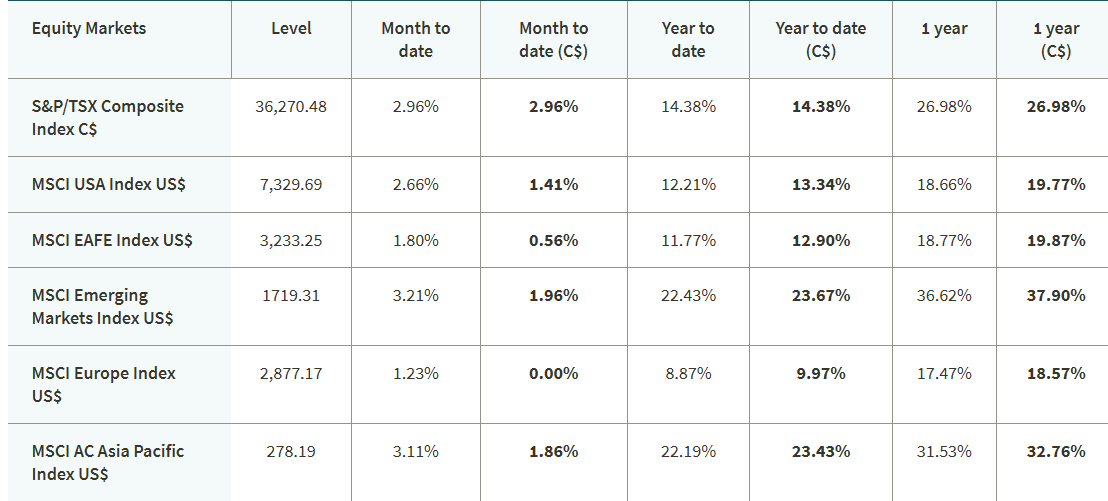
Global equity markets finished higher over the month of August 2026. There were some bouts of volatility as geopolitical tensions in the Middle East showed little signs of concluding, while trade tensions between Canada and the U.S. flared up late in the month. Meanwhile, trading in artificial intelligence stocks remains overall bullish, but there are some concerns about their potentially high valuations. Inflation remained elevated over the month, even accelerating in some parts of the world. Inflation concerns are reemerging, which is leaving investors to wonder if central banks may raise interest rates. Data from major economies showed the global economy continues to expand, albeit at a relatively muted pace, as it faces major headwinds from higher prices, geopolitical tensions and trade disruptions.
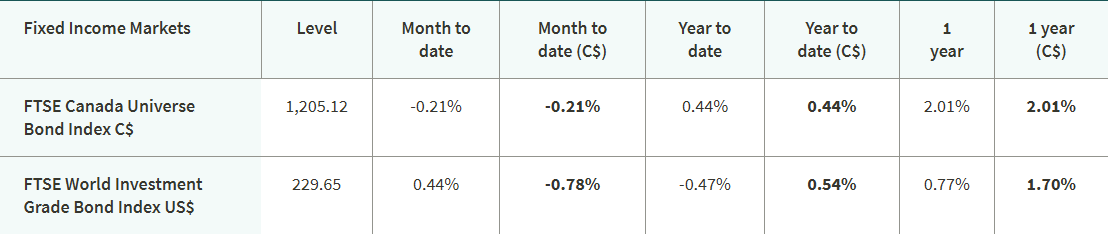
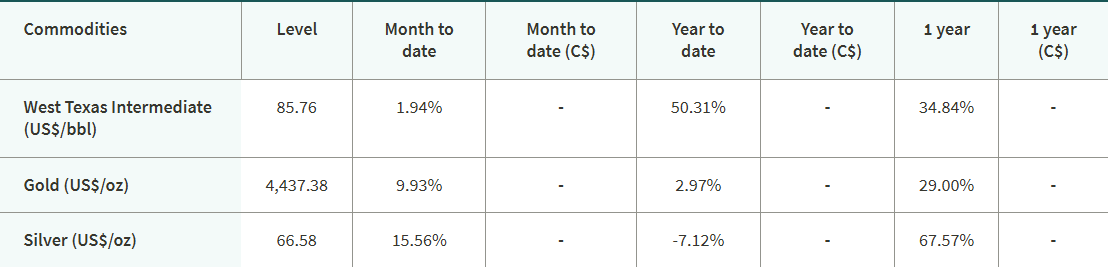
In Canada, the S&P/TSX Composite Index moved higher over the month, getting a strong performance from the materials and information technology sectors. U.S. equities also posted a gain in August. Yields on 10-year government bonds in Canada and the U.S. finished higher. The price of gold increased over the month, while the price of oil finished largely unchanged.
Canada-U.S. trade tensions intensify after negotiations fall apart
Trade tensions between Canada and the U.S. escalated sharply in August after negotiations collapsed just before a midnight deadline for new tariffs to be imposed by the U.S. on Canada. Canadian Prime Minister Mark Carney accused the U.S. of introducing unfair, last-minute changes to the proposed deal, while U.S. Trade Representative Jamieson Greer said Canada had backed away from terms it had already agreed to. In response, the U.S. imposed 50% tariffs on roughly US$20 billion (C$28 billion) of Canadian goods, including dairy, alcohol, cement and hockey equipment. Carney called it an attack on Canada and suspended trade talks. Canada retaliated with tariffs of 15%, 25% and 50% on nearly US$20 billion of U.S. imports, including steel, dairy, appliances and electronics, set to take effect September 8. Given the potential fallout from new tariffs, Ottawa pledged $7.5 billion to support affected workers and businesses. The breakdown adds uncertainty to the review of the Canada-United States-Mexico Agreement, with some economists warning the escalation could weaken Canada’s negotiating position in those talks. Combined with an already strained trade relationship, the dispute raises the risk of prolonged uncertainty for Canadian exporters and could weigh on business investment and economic growth in the months ahead, leaving Canada’s economic outlook more clouded than it appeared just before no trade deal was reached.
Canada’s economic growth accelerates in Q2
Statistics Canada reported in August that the Canadian economy rebounded strongly in the second quarter of 2026, growing at an annualized pace of 3.3%, following two straight quarters of weak economic activity, which raised concerns about a recession. The rebound was broad-based, led by a sharp jump in exports, including a surge in vehicle shipments, alongside solid gains in household spending and business investment in machinery and equipment. A one-time boost to household income, from an enhanced GST/HST credit payment, also helped support consumer spending. Adding to the encouraging news over August was July’s labour market report, which showed the Canadian economy added 75,100 jobs, pushing the unemployment rate down to 6.4%, its lowest level in two years. Job gains were widespread, with retail trade, finance, professional services and construction all contributing, while wages grew by 3.0% year-over-year. These critical reports suggest Canada’s economy may be turning a corner after a rough stretch, with stronger economic growth and a healthier job market pointing to improving confidence among consumers and businesses. While one good quarter doesn’t erase the challenges of the past year, the combination of an economic rebound and a resilient labour market offer a more encouraging signal for Canada’s economy. However, the heightening trade tensions with the U.S. seen in August could hinder the recent progress of Canada’s economy.
U.S. sheds jobs for first time in five months
Data released in August showed a mixed but cooling picture for the U.S. labour market. The official government report showed the U.S. economy lost 23,000 jobs in July, while the unemployment rate edged lower to 4.1%. Job losses were concentrated in local government education, retail trade and financial services, while health care continued adding jobs over the month. Wages grew by 3.2% year-over-year in July. Automatic Data Processing told a somewhat different story in its monthly payroll report, showing U.S. private employers added 44,000 jobs in July, which was below expectations but still positive. Furthermore, June’s Job Openings and Labor Turnover Survey showed job openings fell to 7.4 million, the lowest level in three months, while job quits, a gauge of worker confidence, held relatively stable. Layoffs also stayed low, suggesting employers are being cautious about hiring rather than aggressively cutting staff. Together, these reports point to a labour market that is cooling but not collapsing, with businesses hesitant to add workers amid ongoing economic uncertainty.
European inflationary pressures accelerating
Eurostat reported in August that Europe’s annual inflation rate rose to 2.9% in July from 2.8% in June but eased slightly from a peak of 3.2% in May, keeping it well above the European Central Bank’s (ECB) 2% target. Energy and services costs remained the biggest contributors. Meanwhile, core inflation, which excludes more volatile prices, also inched higher to 2.5% in July. Adding to the concern, Eurostat also reported that retail sales fell by 0.3% in June, with declines in both food and non-food spending, suggesting consumers are pulling back as living costs rise. Only spending on automotive fuel increased, reflecting higher gasoline prices at the pump rather than more driving. Together, the data paint a picture of a European economy where persistently high inflation is weighing on consumer spending, a key driver of economic growth. The ECB, which held its key interest rates steady at its last meeting after raising them in April, may feel pressure to keep monetary policy tight for longer to help bring inflation back toward target, even as economic activity shows signs of softening. Some ECB officials have left the door open to a possible interest rate hike if price pressures persist. Should inflation stay elevated while consumer spending weakens, Europe’s economic outlook could face a difficult stretch of slower growth paired with above-target prices in the months ahead.
Market performance - as of August 31, 2026